agentic-commerce
Agentic Commerce Is Already Here, Even If You Never Let an Agent Check Out
What every ecommerce leader needs to know about AI shopping agents, and how to prepare your tech strategy without betting the business on one outcome
Your next customer may never see your homepage. They might ask ChatGPT, Gemini, or Perplexity to “find a waterproof hiking boot under $200 that runs wide,” read a shortlist of three options, and click straight through to the product page, or increasingly, buy without leaving the chat. Whether you are excited about that future or wary of it, the shift is already showing up in your analytics.
During the 2025 holiday season, Adobe Analytics reported that traffic to U.S. retail sites from generative AI tools rose 693.4% year over year. Growth continued into 2026, with AI referrals up 393% in the first quarter and in March 2026, visits from AI sources converted 42% better than visits from non-AI sources. The base is still modest, but the trajectory and the quality of that traffic are hard to ignore.
This guide explains what agentic commerce is, the three things that the retailers need to be ready for it, why product metadata is the foundation of everything, why 3D product models are the most reliable way to get that metadata right while improving the experience for shoppers, and what you can do now regardless of where your agentic strategy lands.
What Is Agentic Commerce?
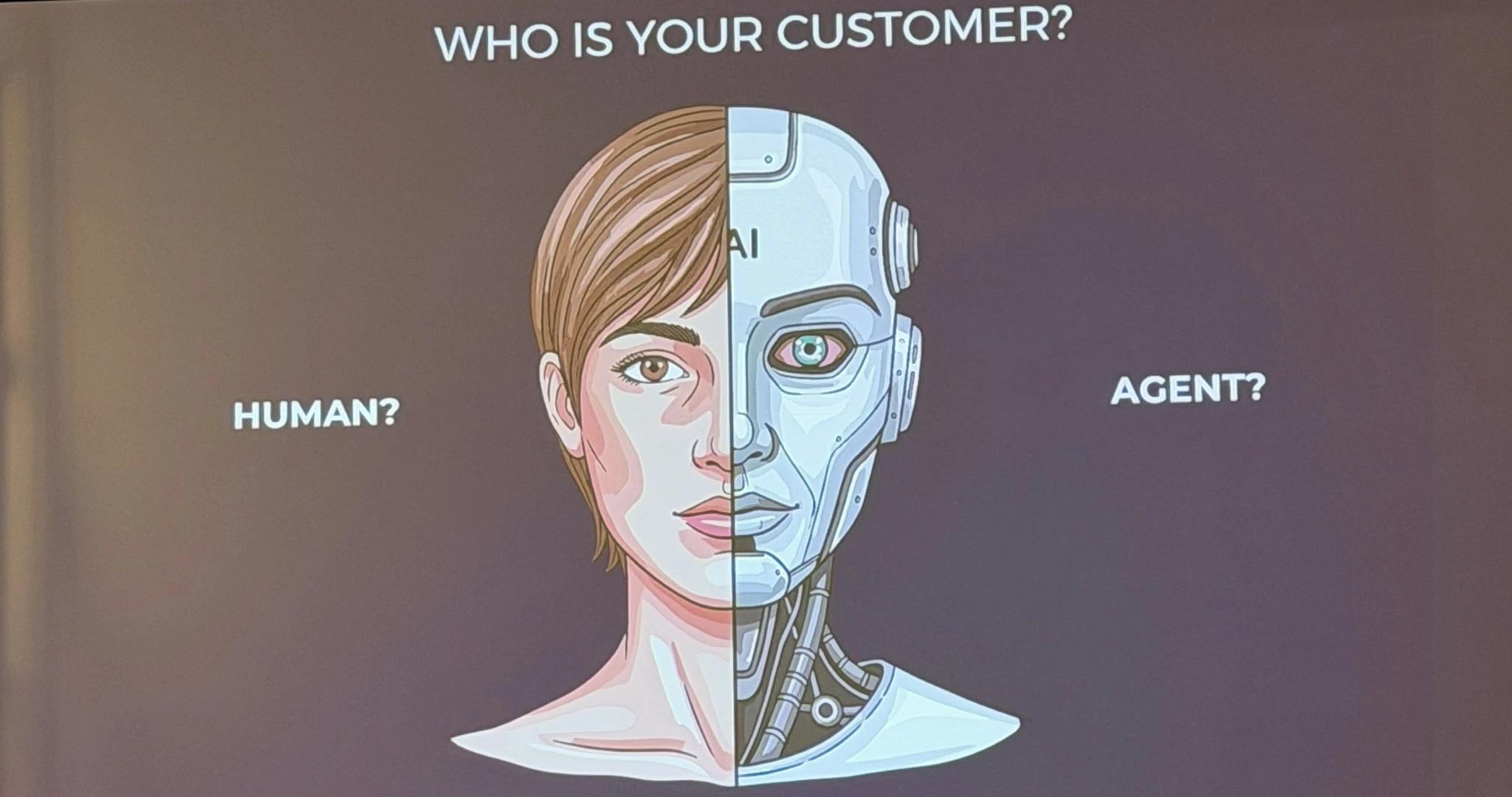
In simple terms, agentic commerce is shopping where an AI agent does some or all the work on a person’s behalf. Instead of a shopper typing keywords into a search bar, scrolling through results, opening ten tabs, and comparing specs, they describe what they need in plain language. The agent then does the research, compares, recommends, and if the shopper allows it completes the purchase.
McKinsey describes this as a shift from shopping as a series of discrete steps searching, browsing, comparing, buying to a continuous, intent-driven flow. The firm estimates agentic commerce could orchestrate as much as $1 trillion in U.S. B2C retail revenue by 2030, and $3 trillion to $5 trillion globally.

Figure: The shopping journey is shifting. In the agentic journey, three of the five steps, research, discovery and recommendations, or about 60% of the journey, move to AI agents today, while agent-led checkout is still emerging.
For retailers, the practical meaning is this:
- Your new “customer” may be software. Agents read your catalog, prices, availability, reviews, and policies, then decide which products make the shortlist.
- Discovery is moving upstream. Much of the research and comparison that used to happen on your site now happens inside an AI conversation before the shopper ever arrives.
- Being invisible to agents means being left off the list. If an agent cannot understand your product, it will recommend a competitor whose product it can.
Not every retailer is welcoming this. Some are opening the door to agents, some let them browse but not buy, and some block them entirely. But every retailer whatever its stance is affected by how shoppers now use AI to research and decide.
What It Takes to Be Agentic-Commerce Ready
Readiness doesn’t require rebuilding your stack overnight. It comes down to three capabilities:
1. Rich, structured product metadata
Metadata is the single most important ingredient. AI agents do not admire your hero banner or your lifestyle photography; they read structured data. Complete, accurate, machine-readable product attributes materials, dimensions, fit, compatibility, care instructions, certifications, use cases, price, stock status, shipping and return terms determine whether an agent can confidently match your product to a shopper’s request.
Here is the part that makes this a no-regret move: richer metadata improves your own on-site search, filtering, and recommendations too. A shopper searching your site for “machine-washable linen dress” gets better results when every product carries clean, consistent attributes. So even if you decide never to sell through an agent, investing in metadata pays off in your traditional ecommerce experience, in classic SEO, and in marketplace and shopping-feed performance.
2. Agent-accessible data feeds and protocols
Agents increasingly consume product data through feeds and open protocols rather than by scraping pages. OpenAI’s Agentic Commerce Protocol (ACP) lets ChatGPT ingest structured catalog data and understand merchant inventory, while Google’s Universal Commerce Protocol (UCP) does similar work across Google’s AI surfaces. OpenAI’s feed specification even calls for refreshes as often as every 15 minutes to keep price and availability current. Readiness means your product information management (PIM) and commerce systems can publish accurate data to these channels and keep it fresh.
3. A flexible, policy-driven commerce layer
Finally, you need architectural flexibility to decide and later change how far agents can go: browse only, add to cart, or complete checkout with the shopper’s explicit approval. That means API-first commerce services, clear bot and agent policies, secure identity and payment handoffs, and analytics that can distinguish agent-referred traffic from everything else. The goal is not to pick a final answer today, but to make the answer a configuration choice rather than a rebuild.
Why Metadata Matters So Much and How to Add It Without Cluttering Your PDP
When an agent evaluates products, it compares facts. As one Shopify agency notes, precise attributes like “100% GOTS certified organic cotton, 200 GSM” consistently outperform marketing copy like “luxuriously soft premium cotton.” Gaps are costly: agents generally won’t recommend products that are not explicitly marked as in stock. In a world where the agent makes the shortlist, data completeness is a competitive advantage.
Humans and agents want very different things from a product detail page (PDP):
- Humans want a clean, visual, scannable page above the fold great imagery, price, the few details that drive the decision, and a clear call to action.
- Agents want everything, every specification, variant, compatibility note, certification, review signal, and policy in a structured form they can parse in milliseconds.
Dumping fifty attributes onto the visible page would serve the agent and ruin the experience for the human. The answer is to layer the information, so each audience gets what it needs:
- Structured data in the page code. Schema.org Product, Offer, ProductGroup, AggregateRating, and return/shipping markup in JSON-LD is invisible to shoppers but immediately readable by search engines and agents.
- Product feeds and APIs. Publish your full attribute set through Google Merchant Center, OpenAI’s product feed, and UCP/ACP endpoints so agents get depth without touching your page layout.
- Rich media with descriptive data. Images, video, and 3D assets tagged with alt text, dimensions, and material data let one asset serve both the eye and the machine.
- Progressive disclosure on the page. Keep the fold focused on what humans need, and move deeper detail into expandable spec tables, tabs, and accordions rendered in the HTML so agents can still read them.
- Structured FAQs and Q&A. Answer common questions (“Does it fit a 15-inch laptop?”) in marked-up FAQ blocks that help shoppers and give agents explicit answers.
The principle is simple: the visible page is designed for people; the data layer is designed for agents. Both are fed from the same single source of truth in your PIM, so they never contradict each other.
3D Models: The Fastest Path to Accurate Metadata and a Better PDP
A well-built 3D product model is one of the few assets that elegantly resolves the human-versus-agent tension. For shoppers, it replaces a wall of text with an experience: they can spin the product, zoom into stitching or texture, check scale, and view it in their own space through augmented reality. For agents, the same model is a container of precise, structured truth: exact dimensions, materials, colors, finishes, and component details that can be exposed as metadata.
The human-side results are well documented. Shopify reports that merchants using 3D commerce see an average 94% increase in conversions, and stroller brand Bumbleride saw a 33% conversion lift and up to 21% more time on page after adding 3D models. Better visualization also means fewer “it looked different online” returns.
Why 3D is the most reliable path to accurate metadata
The bigger idea is that a 3D model is not just a better picture it is a measured digital replica of the product. To build one, every dimension, material, color, finish, and variant must be specified exactly. That discipline makes the 3D model a natural engine for the accurate, complete metadata that agents and your own site search depend on.
Accuracy is not a nice-to-have. Akeneo’s 2025 Consumer Returns Report found nearly 60% of consumers had returned a product because the online description was misleading or inaccurate, and Salsify’s 2025 research put the figure at 71% of U.S. and U.K. shoppers returning an item because of incorrect product content. In an agentic world the cost compounds: bad data doesn’t just trigger a return, it may in some cases not even recommend your product and it misleads the agent that recommended you, which may steer the shopper elsewhere next time.
Here is how a 3D model turns into better metadata:
- Measured, not typed. Dimensions, proportions, and capacities come from the model’s geometry rather than being keyed into spreadsheets by different teams and suppliers.
- Visual attributes become explicit. Color, material, texture, finish, and pattern are defined as named materials in the model and map directly to structured attributes.
- Every variant is complete. Each colorway, size, or configuration is a parameter of the model, so every SKU carries full attributes not just the hero product that got photographed.
- One source, every channel. The same model renders PDP imagery, AR views, marketplace listings, and feed data, so the photo, the spec table, and the agent feed can’t drift apart. IKEA proved this model at scale years ago: about three-quarters of its single-product images are computer-generated from a bank of roughly 25,000 high-resolution 3D models.
- Shopping platforms already ingest 3D as data. Google Merchant Center accepts a 3D model link attribute in your product feed, letting shoppers view the product from any angle and in AR directly on Google Search. The 3D model is itself becoming part of the product record.
- Agents are going multimodal. Google’s AI Mode is powered by Gemini, which understands text, images, voice, and context, and Google Lens matches products on shape, texture, and pattern. Accurate, consistent visuals generated from a 3D model give these systems signals that match the product you actually ship.
“Can’t we just build metadata without 3D?”
You can and you should start enriching attributes no matter what. But metadata built in isolation has weaknesses that 3D directly addresses:
- It’s only as accurate as the person typing it. Manually entered attributes and supplier feeds introduce inconsistencies; two suppliers may use different terms for the same feature. A 3D model gives you a verifiable reference to check every attribute against.
- It drifts away from the visuals. When the spec says “navy” and the photo looks black, the shopper loses trust. Invesp data attributes 22% of online returns to products that looked different than they did online. When imagery and data come from the same model, they stay in sync.
- It serves only half your audience. Metadata alone feeds agents but does nothing for the human on your PDP, so you still must fund photography and visualization separately. A 3D model delivers both from one investment the conversion lift for shoppers and structured truth for agents.
- It’s a one-time cleanup; 3D is a reusable asset. New colorways, configurations, lifestyle scenes, AR views, and future agent formats can be generated from the model without reshoots or re-keying data the same efficiency that drove IKEA to replace much of its product photography.
- It isn’t built for where agents are going. As agents and shopping platforms consume images and 3D directly, text-only metadata will be one input among several. Retailers with a 3D digital twin will already have the richest, most consistent record of each product.
Put simply: metadata without 3D is a list of claims about your product. Metadata generated from a 3D model is a list of claims backed by a precise digital twin accurate enough for an agent to trust and engaging enough for a human to buy.
Shoppers aren’t handing over their credit cards, yet
Retailers skeptical of agentic commerce often point to consumer hesitation about letting AI pay, and the data supports that caution:
- A Visa survey of 2,065 U.S. consumers found 72% had used an AI assistant, but only 23% trusted generative AI to handle payment transactions on their behalf.
- Riskified’s Q1 2026 Agentic Commerce Pulse found 55% of consumers are not comfortable with AI agents making purchases for them, and 53.9% believe AI could increase online fraud risk.
- An ACI Worldwide survey of more than 3,300 U.S. and U.K. consumers found only 7% of fashion shoppers would let an AI assistant buy without their approval.
- A Harris Poll for Quad found only 39% of Americans trust AI agents to make everyday purchases, and 34% for larger items.
But they are using agents to research, discover, and decide
Here is what the skeptics miss. Low trust at checkout does not mean low usage. The same studies show agents are already deeply embedded in three of the five steps of the shopping journey, research, discovery and comparison, and recommendations, or about 60% of the journey:
- In the ICSC and McKinsey study, 68% of consumers had used at least one AI tool in the past three months as part of shopping, and 62% had used AI to compare brands, models, prices, or reviews.
- Riskified found 61.5% of consumers have already used AI tools for product discovery and recommendations.
- RTB House reports 59% of U.S. consumers say AI helps them discover brands they were previously unaware of.
- Worldpay’s 2026 Agentic Commerce Report found comfort with AI stays high through research, price comparison, and recommendations, then drops sharply at payment, yet AI agents were the only purchase channel consumers expect to gain share across every timeframe tested.

Figure: Most shoppers already use AI to research and discover products, but far fewer trust it at checkout. Sources: ICSC & McKinsey; Riskified Q1 2026; RTB House; The Harris Poll for Quad; Visa; ACI Worldwide.
Why does this matter if checkout adoption is low? Because the shortlist is where the sale is won or lost. If an agent narrows a shopper’s options to three products during research and yours isn’t one of them, it doesn’t matter how good your checkout is the customer never arrives. And when they do arrive from an AI recommendation, they arrive ready to buy, which is exactly why Adobe sees AI-referred traffic converting better than other sources.
Execution: Get Ready Now, Decide Later
Retailers are split. As the Wall Street Journal reported in “AI Agents Aim to Change Shopping. Some Retailers Are Locking the Doors.”, QVC is rolling out the welcome mat for agents, Amazon blocks them entirely, and Tapestry’s Kate Spade lets them browse but not buy.
Tapestry’s approach is the one worth studying. The company has been cautious about fully autonomous shopping a Tapestry digital executive told WWD “that world is not here yet”, yet it has invested heavily in getting its systems ready. In September 2026, Tapestry made Coach and Kate Spade products purchasable directly within Google’s Gemini app and AI Mode via the Universal Commerce Protocol, with each transaction requiring explicit consumer approval. Its Chief Information and Digital Officer described the layer as “truly protocol agnostic, so we can quickly move into new AI environments as consumer behaviors evolve.”
That is the lesson: Tapestry didn’t pick a permanent side. It built the data and infrastructure foundation first, so it can open or close the door channel by channel, protocol by protocol as its strategy and consumer trust evolve. You can do the same. Whether or not you adopt agentic checkout, these steps are worth taking now:
- Audit and enrich product metadata. Identify attribute gaps across your catalog and fill them with precise, factual values. Make your PIM the single source of truth.
- Publish structured data everywhere. Implement complete Schema.org markup on PDPs and keep Google Merchant Center and AI-platform feeds accurate and frequently refreshed.
- Redesign PDPs for two audiences. Keep the fold human-friendly and move depth into structured, expandable layers and machine-readable data.
- Invest in 3D and rich media. Use 3D models as the source of truth for dimensions, materials, colors, and variants, starting with high-consideration categories where visualization drives conversion and returns. Feed that data into your PIM, schema markup, and product feeds.
- Set an explicit agent policy. Decide what agents can do today browse, compare, add to cart, or buy with approval and make that policy configurable, not hard-coded.
- Measure AI-referred traffic. Track visits, conversion, and revenue from AI sources separately so your strategy is driven by your own data.
The Takeaway
You don’t have to love agentic commerce to prepare for it. Customers are already using AI agents for three of the five steps of the shopping journey research, discovery and comparison, and recommendations even if most aren’t ready to let an agent hold their credit card. Being ready for those three steps about 60% of the journey keeps your brand on the shortlist and relevant in an agentic world. Build the foundation now clean metadata (ideally generated from 3D models), structured feeds, a two-audience PDP, and a flexible commerce layer so that, like Tapestry, you can switch strategies when the market tells you to, rather than scrambling to catch up.
Sources and further reading
- Adobe: 2025 holiday shopping season results
- AOL: Holiday shoppers are turning to AI. Can retailers deliver? (Adobe Q1 2026 data)
- Digital Commerce 360: McKinsey forecasts up to $5 trillion in agentic commerce sales by 2030
- Retail Dive: US agentic commerce revenue forecast to reach $1 trillion by 2030 (ICSC/McKinsey)
- Riskified: Q1 2026 Agentic Commerce Pulse
- Visa: Consumer Trust in AI-Powered Payments
- Retail Dive: Consumers trust AI to advise, but don’t consent to it purchasing for them (ACI Worldwide)
- Quad / The Harris Poll: The New Rules of Retail Trust in the Age of AI
- Digital Transactions: Consumers like AI for product discovery (RTB House)
- Worldpay: Agentic Commerce Report 2026
- OpenAI: Agentic Commerce Protocol
- Shopify: 3D ecommerce
- Shopify: 3D models and video on product pages (Bumbleride case)
- Ask Phill: Agentic Commerce for Shopify: Protocols, Platforms, and What to Prioritize
- Advanced Web Ranking: Strategic Analysis of UCP and ACP
- Syndigo: Universal Commerce Protocol and the New Rules of AI Shopping
- Wall Street Journal: AI Agents Aim to Change Shopping. Some Retailers Are Locking the Doors.
- Tapestry: Coach and Kate Spade now purchasable in Gemini and Google AI Mode
- Let’s Data Science: Tapestry Deploys Agentic AI to Guide Shoppers (citing WWD)
- Evinent: Marketplace Product Data Quality (Akeneo and Salsify research)
- Corso: The Most Common Ecommerce Return Reasons
- Syndigo: What Is PIM?
- Slate: Most of IKEA’s Product Images Are Computer-Generated
- Google Merchant Center Help: 3D Model Link [virtual_model_link]
- Productsup: Inside Google Shopping AI Mode